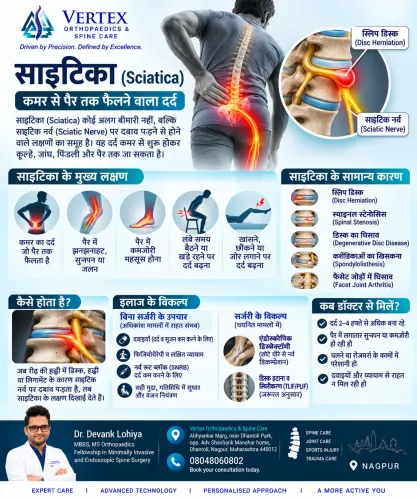
Meta description: Learn about sciatica causes, symptoms, diagnosis and treatment options in Nagpur, including physiotherapy, injections and endoscopic spine surgery.
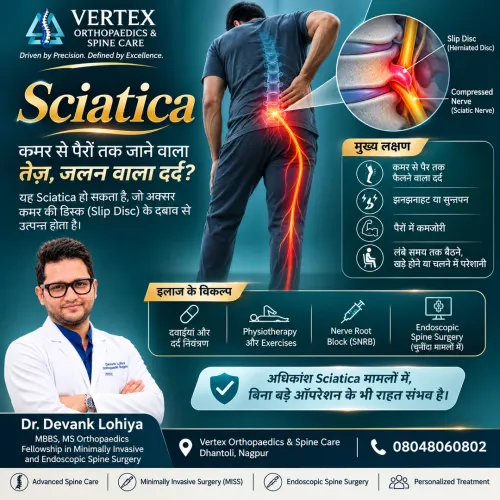
Sciatica causes pain that travels from the lower back through the buttock and into the thigh, calf or foot. It usually develops when a nerve in the lower spine becomes irritated or compressed.
If you are searching for sciatica treatment in Nagpur, it is important to identify the underlying cause before choosing a treatment. Sciatica is a symptom, not a separate disease, and its management depends on the severity of nerve compression and your clinical findings.
At Vertex Orthopaedics and Spine Care, Nagpur, Dr. Devank Lohiya provides evaluation and treatment for sciatica, slipped disc, lumbar disc herniation, spinal stenosis and other spinal conditions.
What Is Sciatica?
Sciatica refers to pain or neurological symptoms caused by irritation or compression of the nerve roots that form the sciatic nerve.
Common symptoms include:
* Lower back pain spreading into the leg
* Sharp, shooting or electric-like pain
* Burning sensation
* Numbness or tingling
* Weakness in the leg or foot
* Difficulty sitting, standing or walking
* Pain that worsens with coughing, sneezing or certain movements
Sciatica usually affects one side of the body, although some spinal conditions can cause symptoms in both legs.
Common Causes of Sciatica
Slipped Disc or Lumbar Disc Herniation
A slipped disc, also called a lumbar disc herniation, occurs when the soft inner material of a spinal disc pushes through its outer layer and irritates a nearby nerve.
It may cause severe leg pain, numbness, tingling or weakness and is one of the most common causes of sciatica.
Lumbar Spinal Stenosis
Lumbar spinal stenosis occurs when the spinal canal becomes narrower and places pressure on the nerves. Symptoms may include back pain, leg pain, numbness or heaviness that worsens while standing or walking.
Foraminal Stenosis
The neural foramen is the opening through which a spinal nerve exits. Narrowing of this opening can compress the nerve and cause radiating leg pain or other neurological symptoms.
Spondylolisthesis
In lumbar spondylolisthesis, one vertebra shifts forward or backward in relation to another. This may narrow the space around the nerves and contribute to sciatica.
Degenerative Disc Disease
Age-related changes in the spinal discs and joints can reduce the space available for nerves and lead to back pain with radiating leg symptoms.
How Is Sciatica Diagnosed?
Diagnosis begins with a detailed medical history and physical examination. Your spine specialist may assess:
* Pain distribution
* Muscle strength
* Reflexes
* Sensation
* Walking pattern
* Nerve tension signs
An MRI of the lumbar spine may be recommended when symptoms are severe, persistent or associated with neurological changes.
MRI can help identify:
* Lumbar disc herniation
* Nerve root compression
* Spinal canal stenosis
* Foraminal stenosis
* Spondylolisthesis
* Other causes of back and leg pain
MRI findings should always be interpreted along with your symptoms and examination. An abnormal scan does not always mean that surgery is required.
Sciatica Treatment in Nagpur
The best treatment depends on the cause, severity and duration of symptoms.
Non-Surgical Treatment
Many patients improve with conservative treatment, which may include:
* Prescribed medicines
* Physiotherapy
* Targeted exercises
* Activity modification
* Rehabilitation
* Selective nerve root blocks
* Epidural injections in suitable cases
Your treatment plan should be guided by a qualified spine specialist, particularly if you have numbness, weakness or persistent leg pain.
Endoscopic Spine Surgery for Sciatica
Endoscopic spine surgery is a minimally invasive technique used in selected patients with nerve compression caused by conditions such as lumbar disc herniation or certain types of spinal stenosis.
During the procedure, a small working channel and high-definition endoscope are used to reach the affected area and decompress the spinal nerve.
Potential benefits in appropriately selected patients may include:
* Smaller incision
* Less muscle disruption
* Reduced tissue trauma
* Earlier mobilisation
* Shorter hospital stay
* Faster return to daily activities
However, endoscopic spine surgery is not suitable for every patient. The appropriate procedure may be endoscopic decompression, endoscopic discectomy, microdiscectomy, minimally invasive spine surgery, fusion or another treatment.
The decision depends on:
* The cause of nerve compression
* Spinal stability
* MRI findings
* Neurological examination
* Duration and severity of symptoms
* Response to non-surgical treatment
When Is Surgery Recommended for Sciatica?
Surgery may be considered when:
* Severe leg pain continues despite appropriate non-surgical treatment
* Imaging shows nerve compr
Keywords